I know its been a little while between posts. I didn’t think I had much to say and have always erred toward only speaking If I had something worthwhile to talk about. Its not that nothing has been happening in the workshop, it just hasn’t been very physical.
Mark Bradley of the Humber fame returned with a box of bits bought at the Bendigo swap meet.

Swap meet find
Turns out some of them (only the forks and head tube as it turns out) belong to a 1893/ 94 Raleigh. Yes you read right 1893. We know this because there are some numbers stamped on the steerer tube that enable us to put a date on it

Raleigh ID
The last couple of months have largely been taken up with research. What did this bike look like and could we rebuild it starting with these parts. Turns out there is there is another one of these bikes here in Melbourne, owned by the very gracious Paul Farren. Paul has lent us his bike in order to measure and copy.
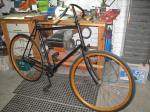
Paul Farrens bike
I set about doing some preliminary work on the existing parts, while another friend of the project in Paul Watson,continued with the research.
The forks had seen better days and needed a bit of work to make them more structural. Even in their original state these forks certainly needed a wheel clamped in them to maintain any rigidity. While we initially thought the head tube was bent I am now more convinced it is merely dented at the front, so a specially made set of tubing blocks have been turned up to squeeze it back into shape. These bikes were built before any sort of standardization came into play so by the time I am finished I think I might have an extra drawer full of oddly sized tubing blocks. Mark is going for the aged look so I am not going to fill every bit of pitted metal.

Deformed fork blades
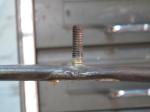
Steps in the process. Dent extraction

Controlled extraction

A bit of filling later
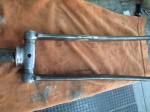
How it should look

Tube blocks for the head tube
As you can see from the pictures the steerer on these forks had seen better days and so for safety purposes I decided to replace it. Again this was a non standard diameter and non standard thread on the end. I turned down a length of Cro-Mo tubing with sufficient wall thickness to allow things to happen. In order to save the identifying numbers I turned a joining piece that was stepped down to the ID of the tubing and cut the original just above the numbers and luckily below the rust. Used the Lathe to cut the thread on the end and brazed it into place. Cut the slot for the head set clamp on the Mill and there you go

Vintage Raleigh- Rusty Steerer
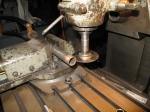
Vintage Raleigh- Steerer slot

Vintage Raleigh- New Steerer
It was time to have a look at the bottom bracket shell and in typical fashion I set about making one. You may wonder why ? Why not just use a already threaded shell without sockets. Well; the Raleigh BB is 90mm wide rather than our traditional 68 or 70mm and the sockets for the seat and down tube are offset to encourage correct chainline. Something early bicycle companies deemed to be very important. Lucky for me the chain stays are fillet brazed on rather than being lugged but they are offset too. It also has right hand threads on both sides and pinch bolts underneath to clamp the cups up tight. The lathe came in very handy

Raleigh BB shell in the making
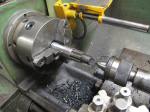
Raleigh BB shell tapping
Tubing Diameters again posed a problem when It came to off the shelf sizes. In particular the top tube which was about 7/8ths of an inch in diameter. I don’t know when even water pipe diameters became standardized but there aint anything out there that would suit this job. I took a thick wall 22mm diameter section of ChroMo and with the help of a moving steady rest on the lathe managed to turn it down to the right size.
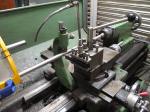
Turning the TT on the Raleigh

1895 Raleigh Tubing
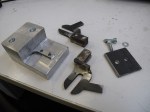
I brazed the ears for clamping the cups onto the BB shell and made up the seat lug.
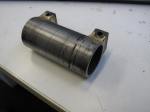
!895 Raleigh BB

1895 Raleigh Seat Lug

Slots in the BB shell

Jigging up the lugs on the BB
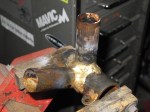
BB shell after Brazing

The foundation of a frame

Finished Raleigh BB shell

Jigging up the Raleigh

Raleigh Downtube and BB

Soaking off the flux

Looking more and more like a bike
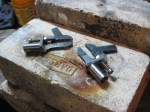
It was time and all that was left to do was the rear end. Paul Watson had got the dropouts laser cut in two parts so I pinned and brazed them together before constructing a fixture to hold them while I turned the end. They were then brazed into the chainstays. So far,so good. The next step involved some messing about with the jig. If you have been following this you will be aware that this is not a conventional frame. So plenty of clamping and propping of support bits needed here. Anyway. The chainstays were brazed to the bottom bracket shell and then the seatstays cut to length. I pinned them to the dropouts so they wouldn’t move and brazed the top to keep everything in place. Then I went back to the dropout end. Lastly, I put in the bridges.




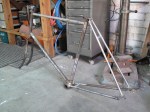
This may be the end but there will be some more photos after the bike hits the road. I think I am as exited as Mark the owner.

Mark’s Raleigh, on the road
Its been a long process. We believe there are only about 12 of these bikes left in the world so suffice to say this is a very exiting project.
 g.duke Handmade Bicycles